I get up and take a first look in my bathroom mirror. It’s not pretty. I didn’t sleep much lately. The little dreams I had were filled with giant soldering irons haunting me, with scary voices uttering gibberish measurements in the background. Yuck. I can’t go on like this. Something has to change. I need to get my stuff together.
Like every normal person when something doesn’t work the way they want I thought about giving up. Do I really need hardware scales? I could just stop my coffee by hand. Or get a 100 euro bluetooth scale. Call it a day and move on. Be happy.
Of course I can’t. Have you ever talked to a three year old about his toys? I have the same mindset: If other people have it I want it too. No matter the cost. I’m ready to go all in.
Going all in means asking for help in the holy Discord channel of wise coffee machine modders. I took pretty pictures of my horrible solder joints. All the connections. The stupid little hole I burned into the PCB with my stupid 4 euro Chinese crap soldering iron. Upload and boom. As I’m waiting for the oracle to respond, I re-read my post. Take a second look at my images.
Learning to read
Funny. I’ve connected the 5V VCC input to a pin that, on closer inspection, reads VDD. VCC is next to it. Only one letter off in the alphabet hehe. I’m wearing a clown nose whenever I work on the machine since I had the little high voltage accident. Maybe I should get matching shoes? How hard is it to read three letters?
I connect the power source to the right pin. Close the case. Power up the machine. Plug the scales. BOOOOOM!!! (The machine didn’t explode) I’m getting a more or less stable reading!!! Is this already a happy end?
Not quite. I’m seeing fluctuations of 3000 grams from time to time. And after trying them I find that one of the two load cells doesn’t work at all. It’s some nice progress, but we’re not there yet.
Connecting the dots
Since I’m an expert at connecting electronic pins, I figure that the D1 pin (data 1) might be not connected. A free floating pin fluctuates more or less randomly and would explain the strange measurements I’m getting.
I go full commando and dig up the data sheet of the component that converts the load cell resistance measurement into a digital signal on the D1 pin. It has the beautiful name HX711. I locate the D1 pin. Fire up the multimeter. No connection to the D1 outlet I burned down last time. Damn. But wait, there’s hope! What about the other outlet. The hole is clogged, but there’s still metal. I check. BEEEEP. Connected.
This is getting exciting. I do a solder job so dirty that you need to be 18+ to watch it. I’m basically gluing the cable onto the sad rests of the pin. It seems to stick. If it’s stupid and it works it ain’t stupid in the end.
Moment of truth
I power up the machine again. Connect the scales. Little prayer. IT WORKS!!!! I’m getting a stable reading. The coffee gods are in my favor. After some calibration my drip tray became a digital scale. I test it with my old tamper (360 grams). 0,4g offset. Honestly, that’s a solid result.
Time to pull a shot of coffee!
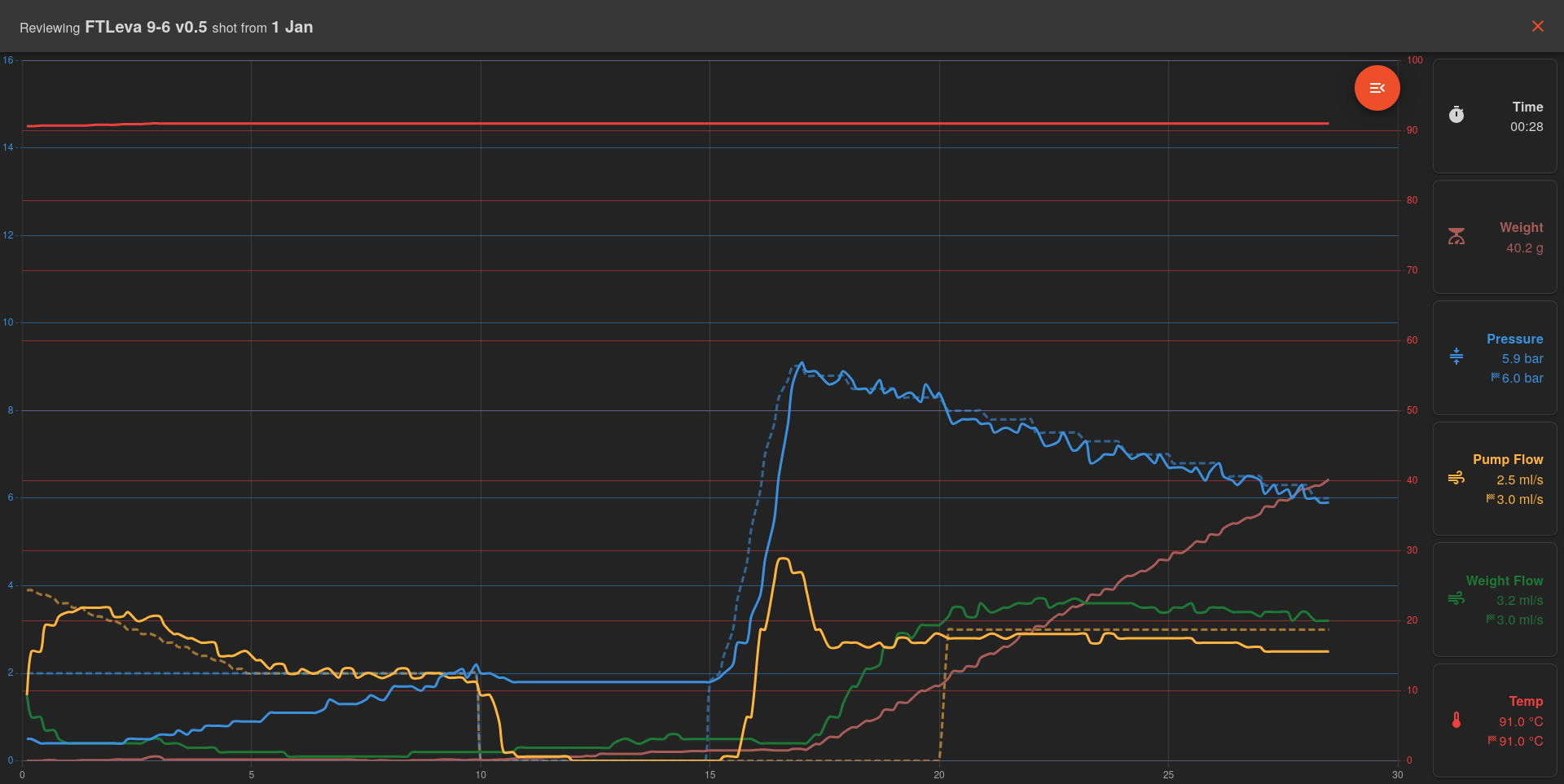
Shot with working hardware scales
Did I put my mental health in danger for another silly line in this diagram? Absolutely. The green line is weight change per second. If you think of the yellow one (pump flow per second) as input, the green line is the output.
The novelty here is that the machine can now do two things that were impossible before:
- It can sense when the first drips of coffee hit the cup. It can use this information to stop the filling phase of the preinfusion.
- It can measure how much coffee liquid is in the cup in total and stop the process once the target weight is reached.
I could do these things by hand before, but it was tedious. If you want a repeatable process, let a computer do the heavy lifting. It will always outperform you in repeatability. Which is why I installed the scales in the first place. Totally not because I wanted another toy.